

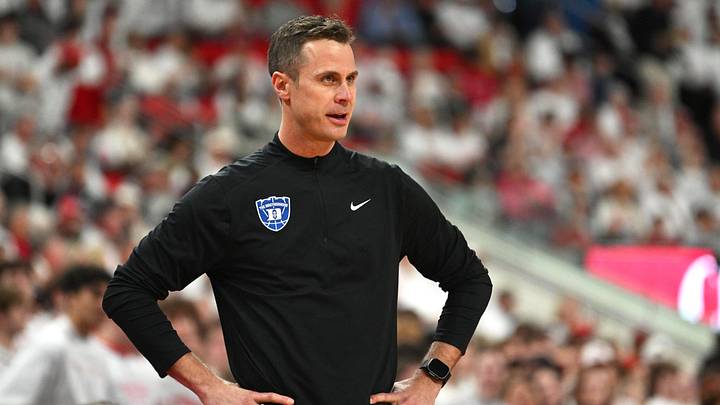
Jon Scheyer signed the No. 1 recruiting class in the country for the 2026 cycle. It's a class that features three 5-star prospects from the American high school ranks, but the most hyped prospect has quickly become an international big man who was the latest addition to the class.
Joaquim Boumtje Boumtje has seen a meteoric rise in recent months, and in the aftermath of his commitment to Duke, he's now being viewed as the potential No. 1 overall pick in the 2028 NBA Draft. After recently turning 17-years-old, the EuroLeague big man isn't eligible for the draft until 2028, but he's far from a project. While his best college basketball will likely come during the 2027-28 season, he looks as if he can have an immediate impact for the Blue Devils.
That is, of course, unless the NCAA throws a monkey wrench into those plans for Duke - and dozens of other college basketball programs.
According to Sports Illustrated's Kevin Sweeney, the NCAA issued new guidance to its member institutions back on May 8th, which lays out updated preenrollment eligibility requirements, mostly stemming from professional team involvement with compensation that exceeds "actual and necessary expenses." According to the NCAA's guidance, those players would be ineligible to play college basketball moving forward.
“Actual and necessary expenses continue to be a factor in a prospect’s eligibility, but as part of that broader effort to update preenrollment rules, the NCAA also identified several international leagues in which participation by a prospect is likely to result in violations of NCAA rules and a loss of eligibility,” an NCAA spokesperson said in a statement to Sports Illustrated. “The Association is modernizing the rule book in several ways to ensure college sports are played by college athletes and not used as a fallback for professional athletes, and the age-based eligibility model now under consideration is designed to address many member schools’ concerns regarding eligibility.”
What is an NCAA guidance and what does it mean?
A guidance is effectively the NCAA laying out its interpretation of the rules to its member institutions and telling them what they can and cannot do. In the past, programs have adopted guidance from the NCAA quickly to avoid any possible rules violations/sanctions, but in this era of judicial meddling to grant eligibility to players the NCAA otherwise ruled ineligible, it's hard to tell how programs will react.
So what does it mean right now? Nobody really knows. The NCAA hasn't yet stated definitively when this guidance will start being enforced, nor to what degree they will enforce it (case-by-case, blanket policy, etc.).
You would think there would be an obvious difference between 17-year-old players like Boumtje Boumtje and the guys Will Wade is signing to play at LSU.
What does this mean for Duke and Joaquim Boumtje Boumtje?
Nothing...yet.
It's a potential roadblock, but not a real one at this point. The fact that this guidance was sent out two weeks ago and teams have continued recruiting and signing international players should tell you how seriously programs are taking NCAA guidance right now.
Boumtje Boumtje has played in the EuroLeague, which, according to Sweeney, has a CBA with minimum contracts of $58,000 (post-tax) per season, which would likely exceed the NCAA's guidelines.
The influx of international professionals began a year ago. Duke was part of that by signing Dame Sarr out of the EuroLeague, but Sarr, like Boumtje Boumtje, was of college age (he'll turn 20 this June).
The problem has been coaches like Wade at LSU, and even Steven Pearl recently at Auburn, signing 22, 23, 24, and even 25-year-old EuroLeague professionals who have multiple kids and a mortgage. That's not exactly the spirit of college basketball.
It's too early to state definitively in any direction what this will mean for Duke or numerous other programs in college basketball. But it's a complication worth monitoring.
 Add us as a preferred source on Google