

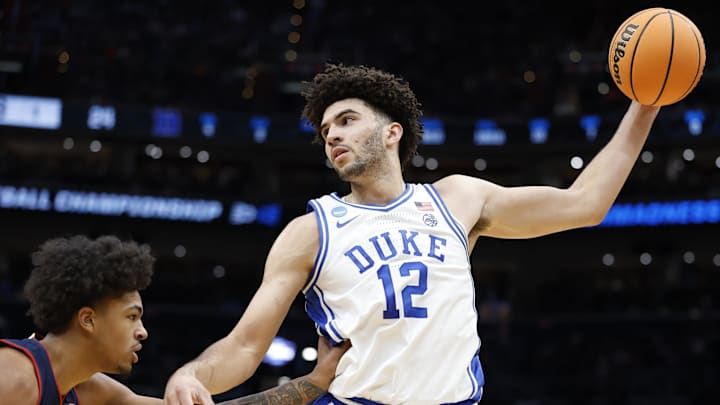
Mike Krzyzewski was reluctant to embrace the one-and-done era when it first took over college basketball, but once he did, he turned Duke into an NBA factory to rival what John Calipari built at Kentucky. A lot has changed, even just since Coach K hung it up in 2022, but Jon Scheyer has continued to channel Duke’s recruiting might to pump out one-and-done stars. Yet, after Sunday’s Elite Eight collapse, the strategy has yet to yield a championship for K’s successor.
Even Coach K only won it all once in Duke’s one-and-done era, with freshman stars Jahlil Okafor, Justice Winslow, and Tyus Jones in 2015. Otherwise, the program’s most legendary freshman campaigns have come and gone without a title to show for it, and now Cameron Boozer’s 2025-26 season can join that list.
But where does it belong in the hierarchy? How big an opportunity did Duke just miss by losing to UConn as the No. 1 overall seed in the NCAA Tournament in the East Regional Final? And how great of a season did it just waste?
Ranking Duke’s best one-and-done seasons to end without a championship
Vernon Carey Jr., 2019-20
The COVID-19 pandemic robbed 25-6 Duke of a chance to play in the NCAA Tournament, and prematurely ended a shockingly dominant freshman season from Vernon Carey Jr. Carey came a few years too early because his old-school offensive game didn’t translate well to the NBA, but without NIL, he made the jump to the next level where he was a second-round pick and played in 37 NBA games before washing out of the league.
At Duke, Carey shouldered a usage rate north of 30 percent and physically dominated, averaging 11.9 points in the paint with over 20 percent of his points coming on second-chance opportunities. Carey didn’t win a title; he never got a chance, but Duke would have likely been a No. 2 seed with Carey as its best player.
Brandon Ingram, 2015-16
Brandon Ingram immediately drew Kevin Durant comparisons in his lone collegiate season before, like Durant, becoming the No. 2 overall pick in the NBA Draft. However, while Ingram was a hyper-efficient scorer, shooting over 40 percent from three, Grayson Allen was the team’s focal point offensively, and Ingram, as he has at the next level, proved to be a tier or so below Durant.
To his credit, though, Ingram was at his best in the NCAA Tournament, averaging 23 points, 2.7 assists, and 6.3 rebounds, playing all but one minute in Duke’s run to the Sweet 16.
Jayson Tatum, 2016-17
Now that he’s been the best player on an NBA Finals-winning team, it’s strange to remember that Luke Kennard was the lead scorer for Duke in 2016-17. However, it was impossible to ignore how easily Tatum could assimilate into the offense, getting to the rim with ease in transition, knocking down open shots off the catch, and generally making the right play.
It’s also odd to think about how such a winning player with a two-way skillset led a two-seed into a second-round upset loss to South Carolina in the NCAA Tournament. In some ways, Tatum’s NBA career has inflated the memory of his year at Duke, but he was still a great player who fell terribly short in March.
Paolo Banchero, 2021-22
Banchero was the centerpiece of Coach K’s final team and lived up to that lofty responsibility. He wasn’t just an efficient isolation scorer, knocking down enough difficult mid-range twos to justify his unorthodox shot diet; he was a high-level offensive creator from the high post, averaging 3.2 assists, the second most on the team, with a 17.5 percent assist rate.
Banchero led a freshman-laden roster to the Final Four, but as they did in the regular season finale and Coach K’s final game at Cameron Indoor, the Blue Devils fell to North Carolina in frustrating fashion.
Jabari Parker, 2013-14
Like a few others on this list, Parker’s NBA career left a lot to be desired, but before he became the No. 2 overall pick, Parker set many of Duke’s freshman records, none of which still stand to today. He was hot down the stretch, including a 30-point, 11-rebound game against North Carolina in the regular season finale, but struggled in Duke’s first-round exit against Mercer as a No. 3 seed, going 4-14 from the field for 14 points with no assists and four turnovers.
RJ Barrett, 2018-19
Duke’s 2018-19 team was supposed to be built around a freshman trio of Zion Williamson, RJ Barrett, and Cam Reddish. Still, ultimately, Williamson and Barrett became one of the most dynamic freshman duos in the history of college basketball. They both averaged over 20 points, were both great rebounders, and could playmaker for teammates. The team lacked shooting and was a bit my-turn, your-turn between Williamson and Barrett, but that doesn’t take away from how prolific a scorer he was.
Marvin Bagley, 2017-18
Marvin Bagley’s skillset didn’t translate to the NBA the way many, particularly in the Sacramento Kings organization, believed it would. However, that doesn’t take away from his dominant freshman season, averaging a 20-point double-double.
That may be a slightly arbitrary statistical threshold, but when it puts Bagley in a five-player group of freshmen with Kevin Durant, Michael Beasley, Carmelo Anthony, and DeAndre Ayton, it’s certainly not meaningless. Bagley lived up to his status as the No. 1 recruit in the country, but fell short in overtime of the Elite Eight against Kansas.
Cameron Boozer, 2025-26
There’s a very real statistical argument to be made that Cameron Boozer just submitted the best freshman season in the history of Duke basketball. By nearly every all-in-one metric, he was the best player in the country this year, and by win shares and wins above replacement, he’s head and shoulders above Cooper Flagg and Zion Williamson. He’s not nearly as exciting as those players, but he was as effective, if not more.
Duke freshman | Cameron Boozer | Cooper Flagg | Zion Williamson |
|---|---|---|---|
RAPM (real adjusted plus-minue) | 10.7 (2nd) | 8.6 (12th) | 8.6 (3rd) |
Win shares | 10.3 (1st) | 8.4 (1st) | 8.2 (2nd) |
WS/40 min | 0.32 (1st) | 0.18 (4th) | 0.33 (2nd) |
PER (Player efficiency rating) | 34.3 (1st) | 31.1 (5th) | 41.3 (1st) |
WARP (Wins above replacement player) | 14.4 (1st) | 11.9 (2nd) | 12.4 (2nd) |
WARP/40 | 0.45 (1st) | 0.42 (3rd) | 0.50 (1st) |
Boozer was the first underclassman since Larry Bird to average more than 20 points, 10 rebounds, and four assists in a season. He constantly made the right decision with the ball in his hands, he was an elite screener, a knockdown shooter, and carved out space on the interior like a pro. So, why isn’t the No. 1? The aesthetics matter a little.
Cooper Flagg wasn’t the human highlight-reel Zion Williamson was, but his athleticism was such a strength. He was an elite shot-blocker from the wing, could defend 1-5, and was more adept at creating his own shot off the dribble than Boozer. When the numbers are close, I’ll defer to the eye test, and Flagg was the better player.
Zion Williamson, 2018-19
Zion Williamson was must-see TV every time he took the floor in that 2018-19 season. That wasn’t every game, which may have foreshadowed some of his impending injury issues in the NBA, but in his 33 games, he was unquestionably the best player in college basketball.
Williamson’s shooting struggles from outside made the 2018-19 team predictable to defend, but that was more the fault of Barrett, Cam Reddish, and Tre Jones than it was the game’s premier downhill attacker. Those spacing issues were bound to rear their head in the postseason, but it’s still hard to believe that team didn’t even reach the Final Four, let alone winning it all.
Cooper Flagg, 2024-25
Cooper Flagg became the 11th Duke men’s player to win the Naismith Award last season and the fourth freshman on the men’s side. He was a dominant offensive player with 19.2 points, 7.5 rebounds, and 4.2 assists, but he was better on the defensive end, also leading the Blue Devils in blocks and steals.
He wasn’t the most refined player as a 17 and 18-year-old freshman, but he played winning basketball. His motor ran as hot as any player in college basketball, and combined with his freakish athleticism and size, he was a force and a great decision maker who did all the dirty work, along with being a primary initiator. It was a rare combination; the type of player you win championships with. But Duke came up two wins short.
 Add us as a preferred source on Google